
Executive Summary
Lubricant supply is becoming less predictable, directly affecting maintenance strategy decisions, particularly in regions structurally dependent on imported base oils. This applies across different base oil types and product groups. Not only for high-performance base oils, but increasingly across multiple product groups.
For maintenance and operations, this introduces a risk that is often underestimated: not the absence of oil, but the inability to rely on availability when it is needed.
Most maintenance strategies assume stable supply conditions. When that assumption breaks, fixed intervals, predefined product choices and standard practices no longer support reliable decisions.
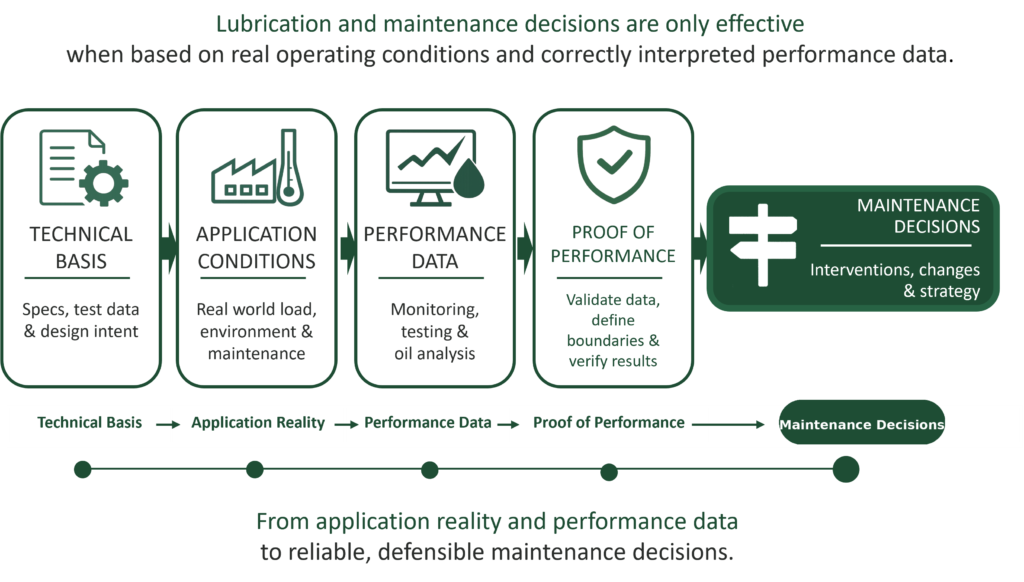
This insight outlines a different approach. Instead of reacting to supply constraints, organisations can manage them by shifting towards structured, data-driven decision making. By combining condition-based monitoring with Proof of Performance, maintenance decisions can be adapted while remaining technically sound and internally defensible.
These adjustments are not without impact. Increased monitoring, additional engineering effort and cross-functional alignment are required. Every deviation from standard practice must therefore be supported by a clear business case, not only in terms of maintenance cost, but in relation to the risk of unplanned downtime.
The objective is not optimisation in isolation, but maintaining operational continuity under uncertainty.
Base Oil Supply: What We Know and What We Don’t
Recent geopolitical developments have highlighted how vulnerable lubricant supply chains can be under changing conditions. Early industry signals indicate disruptions in Group III base oil production and increased uncertainty in logistics and delivery [1].
The Gulf region accounts for a significant share of global Group III production capacity, while Europe remains structurally dependent on imports from this region [7]. As a result, disruptions or uncertainty in this supply chain have a disproportionate impact on European availability
Group I & II base oils are not directly disrupted, but are structurally exposed to refinery economics [2]. In periods of strong fuel margins, base oil production becomes less attractive, leading to shifts in production volumes, particularly for Group II.
Group IV (PAO) is structurally different but not immune. Increased substitution demand and upstream chemical constraints may impact availability.
The key issue is not precise numbers, but direction: supply predictability has decreased [1] and planning assumptions are becoming less reliable.
Why this matters beyond lubricants
Recent developments in adjacent markets illustrate how quickly fluid supply chains can become constrained [3] [6], even when underlying infrastructure remains operational.
Lubricants depend on the same infrastructure:
- Refining,
- transport and
- global trade routes.
As a result, industrial operations should not assume stable availability.
From Fixed Plans to Adaptive Strategy
Traditional maintenance strategies rely on fixed intervals and predefined assumptions. Under supply uncertainty, these assumptions no longer hold.
What starts as a supply issue quickly becomes an operational risk, affecting when and how maintenance decisions can be executed. Decisions around timing, product selection and intervention can no longer be taken in isolation, but require alignment between maintenance, operations and procurement.
In this context, structured decision-making becomes essential. Decisions can no longer rely on standard intervals alone, but must be based on actual condition, constraints and expected consequences.
This is where Proof of Performance (PoP) becomes relevant.
Proof of Performance as decision framework
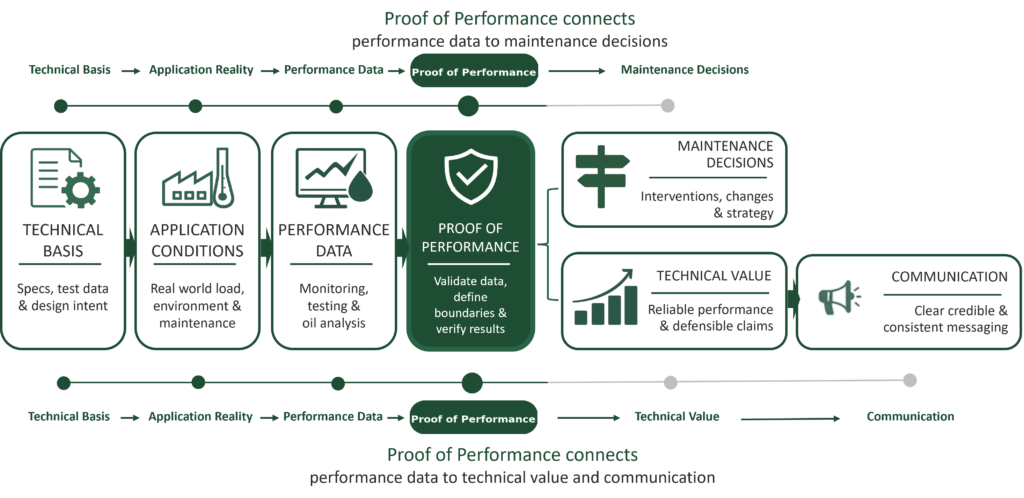
Proof of Performance (PoP) connects condition monitoring data to maintenance decisions.
Condition monitoring provides data. PoP determines whether that data justifies action such as extending oil life or adjusting maintenance intervals.
The key shift is from asking “what is standard?” to “what is still justified under current conditions?”
The model below shows how this Proof of Performance structure connects technical performance to decisions in maintenance and communication.
Practical Application: Different equipment, different decisions
Smaller systems often operate near optimal drain intervals, limiting extension potential. In such cases, upgrading lubricant quality combined with monitoring may be more effective.
Large systems offer more flexibility due to volume and design lifetime. However, extension requires increased monitoring, expanded testing, and trend-based evaluation.
Resource impact and business case considerations
Adaptive maintenance increases resource requirements: more monitoring, engineering effort, and coordination.
Each deviation from standard practice must be supported by a business case, balancing increased maintenance cost against the risk of unplanned downtime.
In periods of increased supply uncertainty, lubricant replacement costs, lead times and availability constraints can become more significant decision factors. This does not change the technical limits of the lubricant, but it increases the value of understanding what remains technically justified based on actual condition and performance.
In practice, this often means accepting higher short-term maintenance cost to avoid significantly higher operational losses.
Supporting this requires more than technical expertise alone. It requires a structured way of working that connects data, decisions and execution in a consistent and defensible way, enabling performance-based maintenance decisions.
Example: Decision making under lubricant supply constraints
In large turbine installations, lubrication systems are typically designed for long service intervals, often operating for several years without a fixed oil replacement schedule. Oil condition is monitored through structured used oil analysis programs, supported by system data such as temperature, load and operating stability.
In one situation, trend analysis indicated a gradual decline in oil condition. While the system was still operating within acceptable limits, the data suggested that an oil change would likely be required in the near term and preparation activities had already started.
At the same time, emerging supply constraints introduced uncertainty around both the availability and future lead time of the required lubricant. Market conditions also increased the potential operational and economic impact of an immediate replacement.
This created a forced decision point: proceed with a planned oil change under increasingly uncertain market conditions, or delay the intervention while maintaining control over system reliability.
A controlled extension was considered, supported by additional measures. One of these was partial oil replacement (“sweetening”), aimed at stabilising oil condition by introducing fresh oil, replenishing additives and diluting degradation products.
However, this is not an immediate solution. It requires:
- Verification of oil compatibility
- Laboratory testing (which introduces lead time),
- Evaluation of the required replacement volume,
- Planning and execution under operational constraints.
Following sweetening, monitoring requirements increase. Sampling frequency must be adjusted and trend analysis becomes more critical to confirm that the intervention has achieved the intended effect.
This type of situation illustrates a broader point. The technical solution itself is not complex. The challenge lies in timing, validation and making defensible decisions under uncertainty.
In practice, uncertainty may relate not only to lubricant availability, but also to lead times, replacement cost and the operational consequences of committing to a decision too early or too late.
Actions such as extending oil life or applying partial replacement are only defensible when supported by data, clear assumptions and a structured evaluation process.
While this example reflects a specific situation, similar decision points occur across many installations when supply conditions become uncertain.
This type of decision cannot be standardised. It must be evaluated in context.
Condition Monitoring as a Safeguard
Condition monitoring becomes critical when deviating from standard practices.
Key principles include increased sampling frequency, trend-based evaluation [4] and integration of machine data.
Practical measures to extend lubricant life
Measures include improved contamination control, optimised operating conditions, partial oil replacement (sweetening) and additive replenishment [5].
These should be applied selectively and validated through data.
What to Avoid
Common pitfalls include ignoring data, applying generic solutions without validation, and deviating from OEM recommendations without documentation.
Conclusion
Supply uncertainty requires a shift from routine maintenance to risk-based decision-making under changing conditions.
Recent industry discussions also emphasise that lubrication professionals, including STLE Certified Lubrication Specialists (CLS), can play a more active role in supporting end-users with condition-based maintenance and oil analysis. In situations of lubricant supply uncertainty, that role becomes important before supply constraints become urgent [8].
As supply conditions, lead times and market dynamics become less predictable, maintenance decisions increasingly require both technical and economic justification.
Organisations that fail to adapt risk making decisions based on outdated assumptions, with direct consequences for reliability and cost.
If this situation is recognisable for your organisation, these issues can be explored in more detail through a focused discussion of your maintenance strategy and decision-making.
References:
- Independent Lubricant Manufacturers Association (ILMA). “ILMA Engages DOE on Base Oil Supply Disruptions Amid Middle East Conflict.” ILMA Top Story – Advocacy, April 8th. 2026. (Details supply impact: 44% of U.S. Group III from Gulf offline; Middle East outages; Group II & IV constraints anticipated)
- Wright, S. ICIS News. “Europe base oils Group II/III players pull offers, braced for tightness from Middle East disruptions.” March 5th. 2026. (European market response: pulling offers, import delays, diesel vs. base oil production trade-off)
- Boucher, H. The Independent (UK). “Europe only has six weeks of jet fuel supply left, energy chief warns.” April 16th. 2026. (Fatih Birol/IEA warning on European jet fuel stocks amid Strait of Hormuz closure; urgency of fuel supply constraints)
- Since the early 2000s, oil analysis data trending has evolved from a primarily visual technique into a statistically supported, predictive decision tool:
- Noria Corporation / Machinery Lubrication “Maximizing Your Condition Monitoring Investment”
- Fitch, B. Machinery Lubrication/Noria Corporation “Follow the Trend for Successful Oil Analysis”
- Fitch, B. Machinery Lubrication/Noria Corporation “…Trends in Lubrication and Oil Analysis”
- Fluitec International on LinkedIn. “Case Study Highlights & Marketing Materials, 2023–2025″. (Claims and data on lubricant life extension through additive replenishment and oil cleaning – e.g. Fill-for-Life program average 2.5× oil life increase)
- International Energy Agency (IEA)-Oil Market Report – April 2026, published April 14th. 2026
- Sam Meredith (CNBC/Argus Media):”Engine trouble ahead?…” May 1st. 2026
- STLE /TLT : The Lubricant Supply Crisis: What the Industry Needs to Do Now – July 7th. 2026 (published in TLT magazine-August 2026)
Published:
Version 1:April 17th. 2026.
Update 1: May 4th. 2026.
Update 2: June 1st. 2026.
Update 3: July 7 th. 2026