Practical validation of technical performance
Technical performance only creates value when it holds true in real operating conditions. In industrial environments, decisions are often based on test results, datasheets or assumptions, while actual applications may differ significantly from test conditions.
Enerene Consulting supports organisations with Proof of Performance: substantiating and interpreting technical performance in the correct application context. The focus is on decision-making, maintenance and credible communication, not on marketing claims.
Who is Proof of Performance relevant for?
Technology, application and maintenance
Proof of Performance is particularly relevant for organisations and teams responsible for the technical validity of performance in real-world applications, such as:
- OEMs and machine builders
- manufacturers of lubricants, additives and technical products
- maintenance and reliability teams dealing with non‑standard applications
Substantiation towards customers and stakeholders
Proof of Performance is also relevant for technical and commercial teams that need to substantiate performance claims towards customers or other stakeholders.
Especially when:
- operating conditions deviate from standard assumptions
- new products or combinations are introduced
- performance is critical for reliability, safety or warranty
Typical challenges in practice
Decision-making and substantiation towards stakeholders
This becomes particularly relevant when standard assumptions break down, such as changing operating conditions or situations where availability and timing can no longer be assumed.
Organisations often face questions such as:
- How do we translate technical performance into reliable decisions for maintenance and application?
- Can performance be credibly substantiated towards customers and other stakeholders, both internally, such as product development, marketing or management, and externally?
Without context and interpretation, data and testing quickly lead to false certainty.
What Enerene does in Proof of Performance
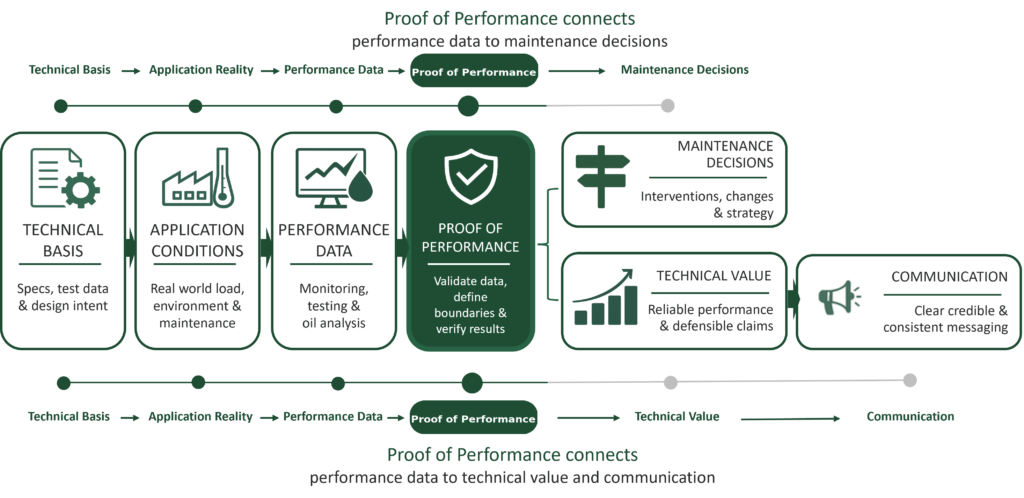
The Proof of Performance model shows how technical basis, application conditions and performance data are connected to maintenance decisions and technical value communication. The framework is common, although the application context, evidence and individual Proof of Performance project may differ between the two fields of work.
1. Performance and context analysis
Enerene starts by analysing:
- available test data and specifications
- application conditions, including load, environment and duty cycle
- maintenance and failure history
- available data from oil analysis, condition monitoring and IIoT
The objective is to understand what was measured and, more importantly, what it means in practice.o understand what was measured, and more importantly what it means in practice
2. Interpretation and practical validation
Based on the analysis, Enerene supports:
- interpretation of test and operational data
- identification of relevant assumptions and risks
- assessment of performance in the actual application
- translation of technical data into maintenance and/or application decisions
This does not result in unnecessary new test programmes, but in focused validation where it truly matters.
3. Substantiation for maintenance and communication
Proof of Performance can result in different outcomes, depending on context:
Towards maintenance and application
- better-substantiated maintenance strategies and decisions
- adjustment of applications or boundary conditions
Towards communication and substantiation
- clear and defensible substantiation of performance within explicit boundaries
- input for case studies, technical documentation, white papers or credible technical value communication
These routes use the same Proof of Performance framework but generally involve different application contexts, evidence and projects. In some cases, such as work for an OEM, the outcomes may support both internal decisions and external communication.
What does Proof of Performance deliver?
- better-substantiated technical and maintenance decisions
- reduced failure risk due to incorrect assumptions
- higher reliability in non-standard applications
- credible and consistent performance substantiation
- increased trust among customers and internal stakeholders
Enerene connects technology, data and application into actionable insight.
Contribution to sustainability and the Sustainable Development Goals (SDGs)
By improving the quality of technical and maintenance decisions, Proof of Performance can support longer asset life, more efficient use of lubricants, materials and energy, and more credible performance claims. Depending on the application and evidence, this may contribute to SDG 9 and SDG 12 and, where demonstrable, SDG 7 and SDG 13. Any contribution is assessed within the specific application context rather than claimed in advance.
Why Enerene Consulting?
- Deep technical expertise in lubricants, maintenance and tribology
- Experience in data interpretation and evidence‑based decision‑making
- Insight into maintenance, product and market context
- Vendor‑neutral and independent
- Focused on practical relevance and decision‑making, not theoretical reports
Related insight
Technical measurements can provide valuable information, but without application and operational context they can create a false sense of certainty.
Read: Oil Analysis Interpretation and the Risk of False Certainty
Get in touch
Do you have questions about the reliability of technical performance or would you like to test assumptions in your specific application?
Contact us for an exploratory discussion on Proof of Performance.
Reference:
Similar challenges around performance validation can be observed in other domains. In automotive lubrication, differences between “suitable for use” claims and fully tested, OEM-approved products illustrate that performance is not always supported by complete validation data.
This is not about approvals as an objective in itself, but about a broader issue: without structured validation, decisions rely on assumptions rather than verifiable performance in a given application context.
Source: Lubrizol — The Importance of Testing: Analysing Quality, Validation Processes and Reliability (September 2025)