Interpreting oil analysis in relation to system behaviour and maintenance decisions
When system behaviour raises questions beyond oil analysis
In the first article of this series, it became clear that varnish is rarely a standalone lubrication problem. It develops within a broader context of maintenance strategy, organisation and operational constraints. Measurements and analyses play an important role, but they never provide the full answer on their own.
In practice, the need for additional information does not arise because varnish is immediately visible, but because systems show behaviour that may indicate its development. Examples include increasing oil or bearing temperatures, reduced performance or recurring alarms. Oil analysis can also provide signals, for example through an elevated MPC value or other indicators pointing to the formation of particles in the oil that may lead to deposits.
These signals often lead to assumptions. Although something is changing, the situation may still appear stable at first sight: values remain within limits, the system continues to operate and intervention can seemingly be postponed. Those assumptions are understandable, but they assume stability while the signals indicate that the system is changing. In that context, measurement is a logical next step, but not the starting point of the problem.
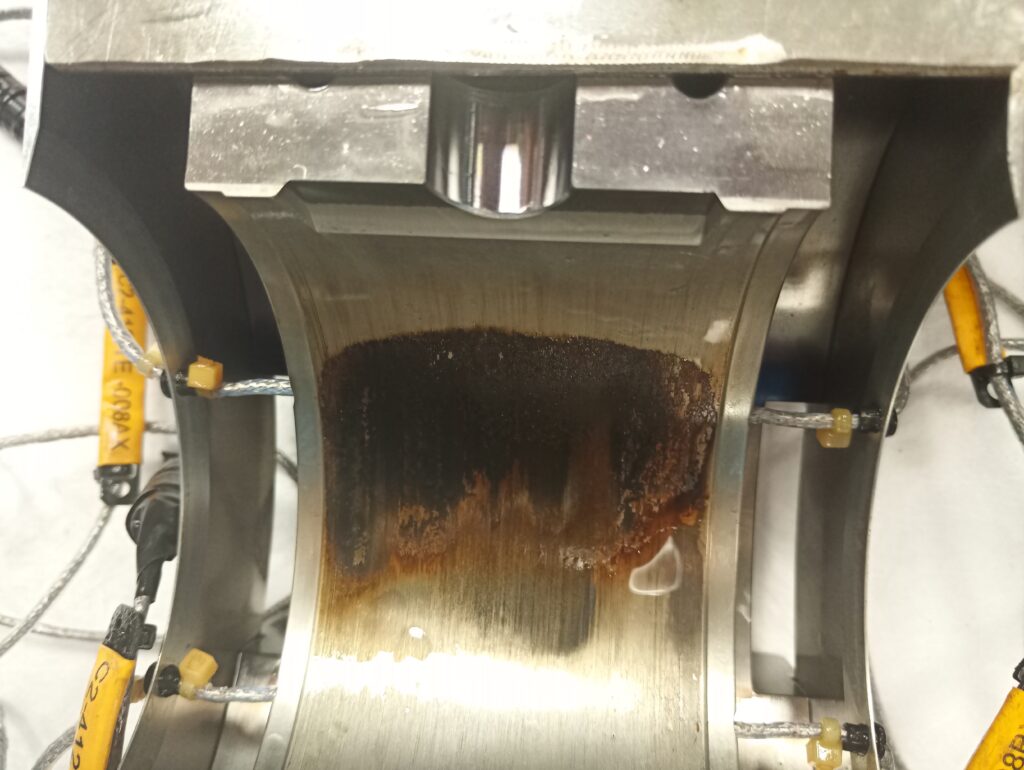
Visible varnish deposits in an industrial systemustrieel systeem
Much has been written in recent years about varnish and related measurement methods. The purpose of this article is explicitly not to provide a complete overview of all available measurement methods or to compare their advantages and disadvantages. The focus is on the insights and practical examples discussed during the OilDoc Varnish Symposium.
Example of varnish deposits in industrial systems. Source: Fluitec NV, Belgium. Used with permission.
The presentations during the symposium showed that there is a tension between what measurements suggest and what actually takes place inside systems. Theory and laboratory research provide important explanatory models, but practice can deviate from them. Even when measured values remain within acceptable limits.
This article therefore does not primarily examine the measurement methods themselves, but their interpretation. Based on research results and practical cases, it discusses where measurements support decision-making, where they can lead to a false sense of certainty and why additional context remains essential.
In this way, the article forms a bridge between the strategic framework discussed in article 1 and the practical mechanisms addressed in the next article.
Varnish formation: what research shows
Structure and composition of varnish layers as a function of depth
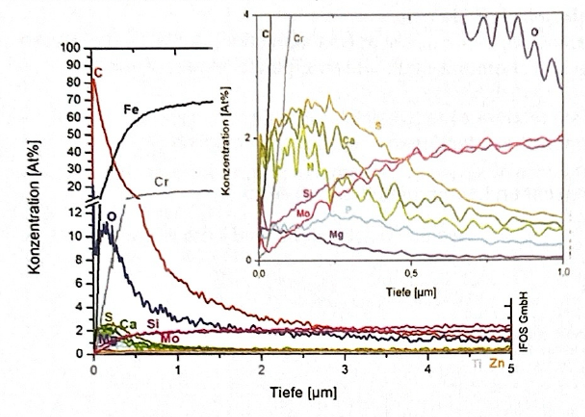
Research into varnish formation by the Mannheim University of Applied Sciences often focuses on how deposits are formed and which factors influence that process. During the symposium it became clear that varnish is not a uniform phenomenon. Deposits can differ in composition, thickness and location, depending on local conditions within the system.
Source: IFOS Kaiserslautern. Used with permission.
Varnish deposits are not uniform
By analysing individual layers of the varnish deposit and integrating the results across the surface, insight can be gained into the total amount of deposit material at specific locations in the system. This emphasises that varnish is not an all-or-nothing phenomenon, but the result of gradual and often location-specific processes.
These insights are important because many measurements focus on the oil as a whole. This creates the risk that local processes, where temperature, pressure and oil circulation interact, are not sufficiently included in the assessment..
Why local conditions matter
At the same time, research shows why this tension is so persistent. Many existing ageing and screening methods are performed under stationary laboratory conditions and do not sufficiently account for the dynamic tribological loading that occurs in machines. Factors such as thin oil films, high contact pressures, local shear rates and varying thermal loads appear to be decisive for the formation and growth of varnish deposits.
Although tests such as MPC provide valuable information about the varnish potential of used oil, they do not, on their own, fully explain how the system behaves in practice under different local conditions.
Measurement values and their limitations
In practice, indicators such as the MPC value are often used to assess the tendency towards varnish formation. An elevated MPC value can indicate an increased presence of varnish precursors in the oil and can therefore be a valuable signal.
An important practical limitation of the MPC test is that its practical value mainly lies in assessing oils that have already been exposed to operating conditions. For fresh oils, MPC alone does not provide a direct prediction of how the oil will behave under the dynamic thermal and tribological conditions found in operating machinery. Specialised screening approaches may provide additional insight, but their results still need to be interpreted in relation to the conditions they simulate.
MPC values as useful indicators, not final conclusions
At the same time, it was emphasised several times during the symposium that a low or stable MPC value does not automatically mean that varnish-related problems are excluded. Measurements provide information about the condition of the oil at that moment, but they do not always reveal what is happening locally inside the system.
This makes clear that measurement values need context. Without knowledge of load, temperature behaviour and system performance, measurements can create a sense of certainty that is not always justified.
When measurements appear acceptable, but systems behave differently
One of the practical examples discussed during the symposium clearly illustrated this tension. In this example, common oil analysis indicators remained within acceptable limits. At the same time, the system showed changing temperature behaviour, visible as a characteristic sawtooth pattern in the trend data.
Temperature trend despite acceptable oil analysis values
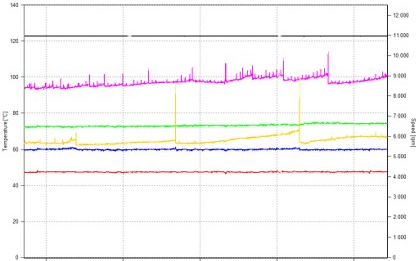
Temperature trend despite acceptable oil analysis values. The yellow and pink lines indicate bearing temperatures. Source: Fluitec NV, Belgium. Used with permission.
Example in which common oil analysis indicators can remain within acceptable limits while the temperature behaviour of the system changes. The yellow and pink lines indicate the bearing temperatures. Such deviations can justify further investigation, even when oil analysis alone does not provide a direct reason for intervention.
Source of graph: Fluitec, Belgium
Only after further inspection it may become clear whether local deposits or other system related factors play a role in the abnormal behaviour. In such cases, oil analysis alone may not provide a direct reason for intervention, while the system behaviour does show signals that justify further investigation.
Examples like this show that measurements are not final conclusions, but part of a broader assessment framework. Without additional context, a measurement value can create a sense of certainty that does not always match the behaviour of the system.
Interpretation as the core of decision-making
The recurring theme in the discussions during the symposium was not which measurement method is “the best”, but how measurement results are interpreted. Measurements help make changes visible, but on their own they do not distinguish between temporary behaviour and structural changes in the system.
When measurement values are viewed separately from their context, there is a risk of false certainty. Decision-making then remains implicitly based on assumptions of stability, while the signals actually point to change.
Effective decision-making therefore requires more than measurement data alone. It requires connecting oil analysis with system behaviour, operational conditions and maintenance objectives. Only in that context can measurements fulfil their role in supporting maintenance decisions.
Reflection and outlook
This article shows that measurement in varnish-related issues is necessary, but never sufficient on its own. Measurement methods provide valuable signals, but they lose much of their meaning without interpretation in the right context.
This article is also available in Dutch:Varnish en schijnzekerheid: de valkuil van losse meetwaarden
Next: why local system conditions matter beyond oil analysis.