
After article 1 established the strategic framework around reliability and maintenance culture, article 2 focused on the interpretation of oil analysis and the difference between laboratory certainty and operational reality.
An oil analysis may indicate that the condition of the oil is still acceptable, while the behaviour of the installation tells a different story. Increasing temperature trends, strongly fluctuating bearing temperatures, contaminated control components or abnormal system responses are not always directly visible in standard oil sample analyses.
Part of the explanation lies in the fact that industrial lubrication systems do not behave uniformly under operating conditions. Local temperatures, (ultra)thin oil films, oil circulation and contamination can cause the oil condition in highly loaded zones to differ from the condition of the oil that is ultimately sampled for analysis.
Local loading in lubrication systems
In hydrodynamic lubrication, rotating surfaces are separated by an (ultra)thin oil film. Under normal conditions, this prevents direct metal-to-metal contact and supports stable operation of the system.
In practice, however, these local lubrication zones are exposed to combinations of:
- high shear stress
- elevated local temperatures
- varying loads
- local differences in oil circulation
Ultrathin oil films and local oil stress
Under these local conditions in particular, changes in oil condition can occur more rapidly, long before they become clearly visible in standard oil analyses.
In practice, relatively small deviations in system conditions can already have a noticeable influence on local loading and oil stress. In one plain bearing application, it was later found that insufficient bearing clearance, just outside OEM tolerances, resulted in operating temperatures that were structurally higher than expected. Although the oil condition remained acceptable, local conditions were present that promoted the formation of deposits.
Shaft in a plain bearing with ultrathin oil film and varnish layer
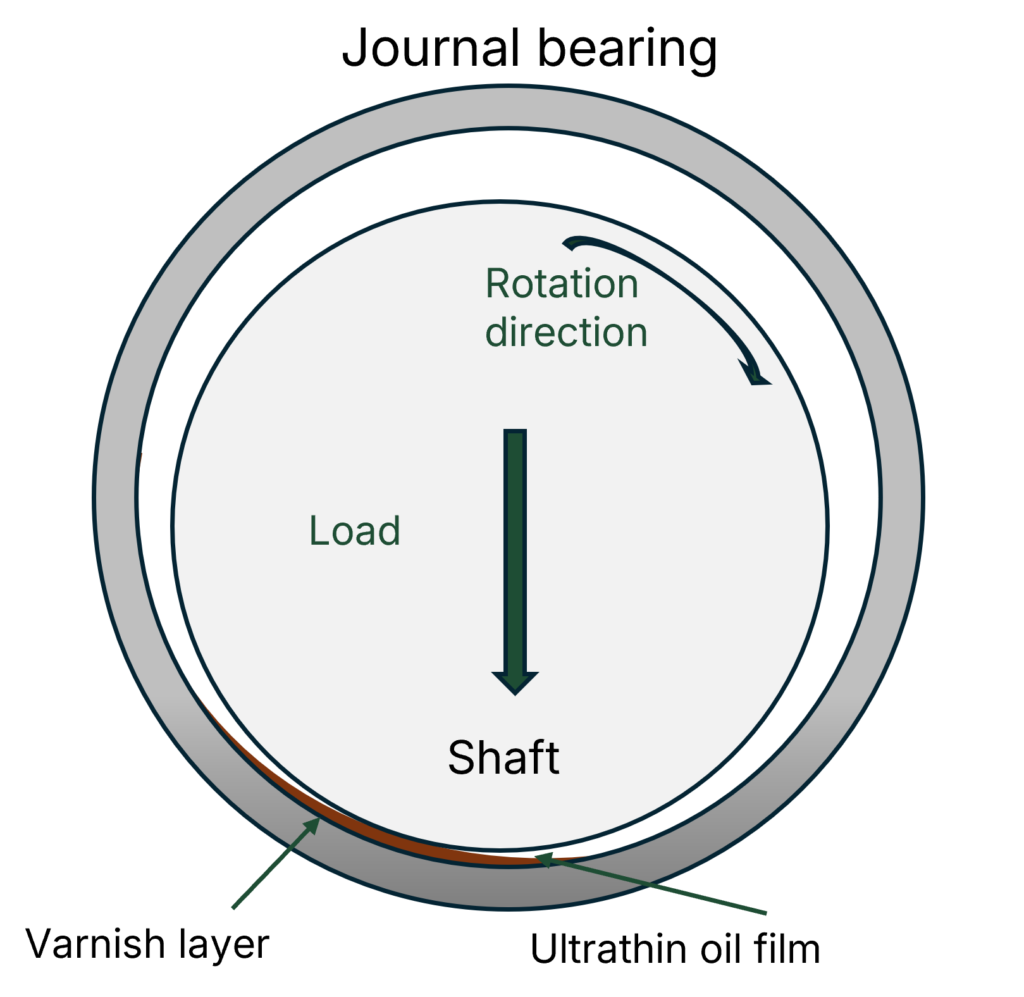
This is particularly relevant in systems where varnish formation, thermal instability or deposits can develop gradually over time.
The deterioration of oil condition often does not occur homogeneously throughout the full oil volume, but rather in locally highly loaded zones such as plain bearings, servo and control valves and other locations where temperature, load and oil circulation differ locally.
Storage & Handling: loss of quality before commissioning
Quality loss during outdoor IBC storage:
An often underestimated aspect is that lubricating oil can already deteriorate in quality before it is put into service. When lubricating oil is stored outdoors in IBC containers for extended periods, UV radiation and elevated temperatures may accelerate oxidation and ageing processes.
In addition, large temperature fluctuations can cause drums or containers to “breathe”. As a result, humid air, water and contaminants may enter the container, contributing to condensation, contamination and additive degradation before the oil is actually put into service.
In practice, long-term storage of turbine oil in standard IBCs and direct sunlight has been shown to contribute to accelerated ageing of the oil before commissioning. The condition of the oil at the point of use may therefore already differ from the expected quality of fresh oil.
The purpose of this article is not to discuss oil quality in relation to OEM specifications during oil changes or commissioning in detail. The example mainly shows that storage can influence the quality of the oil at the point of use, while this aspect is often underestimated in practice
Temperature trends and thermal instability
A recurring operational signal associated with deposit formation and varnish-related instability is a gradually increasing operating temperature.
Deposits in plain bearings, control components or lubrication oil channels can disturb heat dissipation and increase local thermal loading.
Temperature trends as operational signals
Increasing and fluctuating bearing temperatures over time
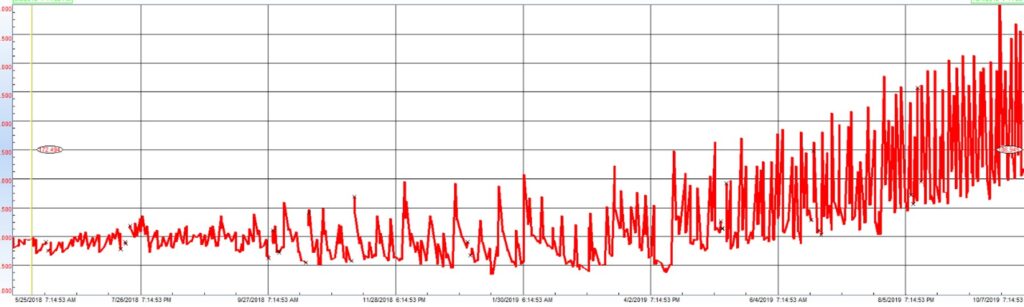
Example of increasing and more strongly fluctuating bearing temperatures over a longer period. Source: Fluitec NV Belgium. Used with permission.
This can contribute to:
- local hotspots
- increased friction
- unstable system behaviour
- accelerated ageing of the oil
- accelerated formation of deposits
In some cases, temperature deviations develop gradually over a longer period before operational problems become fully visible.
The system may then enter a self-reinforcing cycle in which higher temperatures further accelerate oil ageing and deposit formation.
Why oil analysis does not always explain system behaviour
Industrial lubrication systems operate under dynamic conditions that can differ significantly from one location to another.
Traditional oil analyses are essentially a snapshot. As a result, standard laboratory analyses do not always fully describe:
- local thermal loading
- temporary or developing operational deviations
- local deposit formation
This does not reduce the value of oil analysis. Consecutive analyses can reveal trends and fulfil a predictive function, provided that results are assessed systematically and not treated as isolated data points. It does, however, underline the importance of interpretation within the broader operational context of the system itself.
From signal detection to maintenance decision-making
Understanding system behaviour therefore requires more than individual measurement values alone. It requires insight into the interaction between operating conditions, oil condition, local loading mechanisms and system design over time. In that context, it is not only the measurement value itself that matters, but especially how it changes over time.
Recognising a deviation is only one part of the challenge. At least as important is the question of when the available information is sufficient to intervene responsibly. This step from signal detection to decision-making is the subject of the next and final article in this series.
This article is also available in Dutch: Lokale systeemcondities en verborgen oorzaken van afwijkend systeemgedrag
Next: from technical signals to maintenance decisions under uncertainty.