
Introduction
On 10 and 11 March 2026, the Varnish Symposium took place at OilDoc in Germany. The symposium differed from earlier events because varnish was not approached from one specific application only, but from several industrial perspectives.
In recent years, varnish-related events have often been linked to specific sectors or installations, such as turbines or hydraulic systems. This symposium brought together maintenance strategy, research, monitoring, oil analysis, varnish control and practical experience from industry.
The focus was not only on technology and maintenance, but also on the operational context in which installations must continue to run and maintenance decisions are made in practice.
A number of topics and presentations are worth discussing in more detail, with the aim of sharing knowledge that is relevant for industry in general and certainly also for the lubricants industry. The focus is not on product solutions, but on maintenance choices, data interpretation and insights from industrial practice.
This first article focuses on the relationship between reliability, maintenance culture and lubrication programmes, based on the presentation by Bilfinger SE on day 1.
Why varnish remains relevant for reliability and maintenance strategy
Varnish problems rarely stand alone. In industrial practice, they often become visible against a background of ageing installations, increasing pressure on operational availability, shrinking maintenance budgets and a structural loss of experience and specialist knowledge.
At the same time, installations are becoming more complex and lubrication & maintenance decisions are increasingly made under time pressure. That pressure is often reinforced by operational requirements, such as limited maintenance windows, high availability expectations and varying system loads.
In this context, varnish is often approached as a technical or chemical problem: a deposit that needs to be measured, removed or prevented. The presentations during the symposium showed that varnish is often not isolated, but connected to broader choices in maintenance, organisation and execution.
It touches reliability, cost control and sustainability at the same time. For that reason, the topic is highly relevant for the lubricants industry. It is not only about the oil itself, but also about the systems and operating conditions in which installations must continue to perform.
From maintenance extremes to the economic optimum
In its presentation, Bilfinger SE described the tension in which many maintenance organisations operate.
On one side are cost-driven strategies, in which maintenance is postponed as much as possible and installations are operated until a failure occurs. On the other side are strategies primarily aimed at preventing downtime, with intensive preventive maintenance programmes and high inspection frequencies.
Both extremes can lead to inefficiency in practice. Run-to-failure strategies ultimately lead to breakdowns and high repair costs, while unnecessary maintenance results in costs without a demonstrable improvement in reliability.
Between these extremes lies the economic optimum.
In practice, this optimum is also influenced by operational constraints, such as production planning, availability of personnel and the extent to which maintenance can actually be scheduled. In this approach, maintenance is applied more selectively, with greater attention to installations where failures are more likely or would have greater consequences.
The lubrication programme also takes on a different role in that perspective.
Reliability is not a tool, but a culture
An important message in Bilfinger SE’s presentation was that reliability is not primarily determined by individual tools, techniques or measurement methods, but by the way an organisation deals with maintenance.
Reliability is therefore not a separate instrument, but the result of choices in behaviour, responsibilities and cooperation within an organisation.
The Reliability Culture Ladder
The Reliability Culture Ladder shows that organisations can be at different levels of maturity. In more reactive cultures, problems are mainly addressed when failures occur. The relationship between maintenance and operations also plays an important role.
When operational priorities consistently outweigh technical requirements, situations arise in which signals are recognised but not followed up in time. Signals may be observed, but they are not consistently translated into structural improvements.
In such environments, varnish problems often return, despite additional measurements, analyses or temporary measures.
Only when reliability is embedded in processes and decision-making does the focus shift from symptom control to controlling root causes. The ladder makes clear that measuring alone is insufficient.
Discipline, alignment between departments and the ability to translate information into maintenance choices are essential. In that sense, varnish is not a technical detail, but an indicator of the maturity level of the maintenance organisation.
Reliability Culture Ladder and maintenance maturity
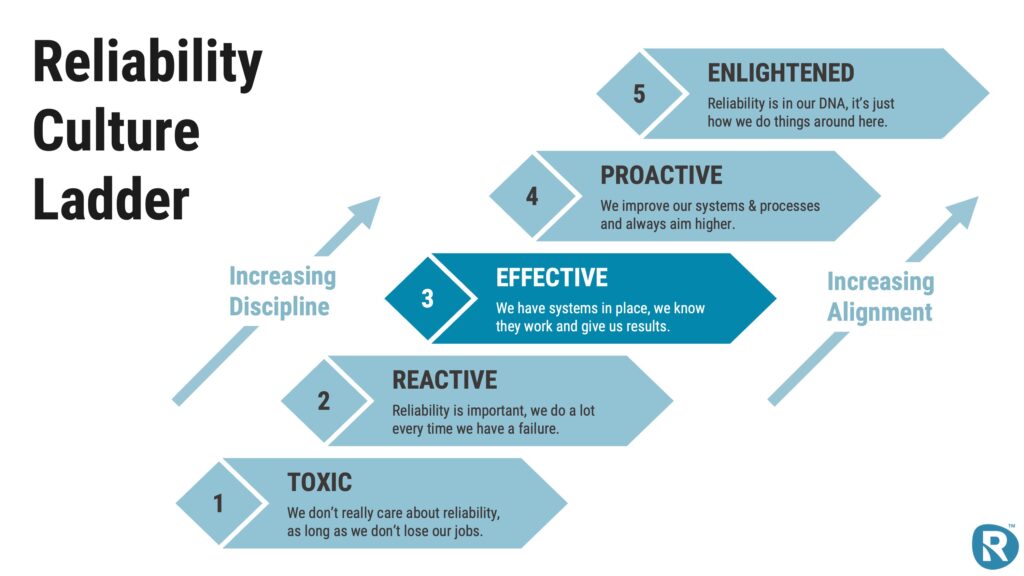
Reliability Culture Ladder. Source: Reliability Academy – Erik Hupjé. Used with permission.
Autonomous maintenance and housekeeping
In addition to maintenance strategy and culture, the presentation also paid considerable attention to the quality of daily execution.
Many reliability problems do not arise from complex technical shortcomings, but from basic conditions that are not sufficiently controlled. Housekeeping, correct lubricant storage and the timely recognition of deviations play a greater role than is often assumed.
Bilfinger SE referred to the shift towards autonomous maintenance, where “maintenance” is not solely responsible for all inspections, but operators are also involved in inspection, cleaning and basic maintenance tasks.
Ultimately, this contributes to the early detection of changes in the installation. Deviations in oil colour, appearance or foaming are noticed sooner when employees take responsibility for the daily functioning of their installation.
This helps prevent small deviations from remaining unnoticed and developing into larger problems.
Used oil analysis as support for maintenance decisions
Within a maintenance strategy in which maintenance activities are prioritised based on application, risk and impact (risk based maintenance, RBM), used oil analysis primarily has value as a feedback mechanism.
The objective is not to measure as many parameters as possible, but to monitor trends in oil condition, contamination, ageing and water content and to link these trends to operating conditions and maintenance actions.
Used oil analysis, especially the monitoring of trends, only delivers real value when measurement results are interpreted within their application context.
A deviating measurement value does not automatically require intervention. It is the combination of trend, application and risk that determines which action is meaningful and economically justified.
During the symposium it became clear that measurements without context can lead to a false sense of certainty, while properly interpreted data can support maintenance decisions.
From changing oil to preserving oil
A recurring theme in the presentation was the shift from changing oil to preserving oil.
Instead of standard oil changes, more attention is being given to extending oil life through condition monitoring and targeted measures. This can ultimately contribute to lower costs, higher installation availability and reduced environmental impact, for example through lower oil consumption and reduced CO₂ emissions.
This approach requires a different way of thinking.
The oil change is no longer the central point. Instead, the focus shifts to understanding the limits of the oil in the specific application. Only then can the appropriate measure be determined.
Oil is increasingly seen as a manageable asset rather than a consumable item.
Innovation in practice: targeted water reduction
As a practical example, Bilfinger SE presented an application in which an innovative and patented Vandalai method for water reduction in lubricating oil was applied at an industrial customer.
Instead of a full oil change, a separate installation was used to structurally reduce water contamination. The associated graph showed that the water content in the oil was clearly reduced while the oil quality was preserved.
Targeted water reduction in lubricating oil:
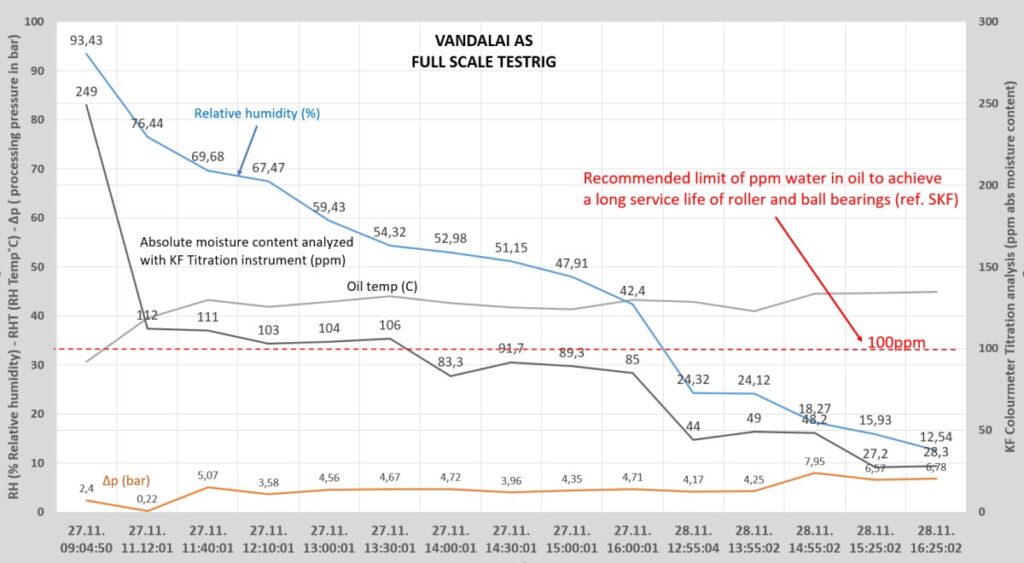
Example of targeted water reduction in lubricating oil. Source: Bilfinger SE and Vandalai. Used with permission.
This example illustrates that innovation can add value when it is applied based on a clear understanding of the problem and the application. It is not about a generic solution, but about a targeted intervention.
What does this mean for lubrication programmes?
The presentations during the symposium made clear that varnish is not an isolated lubrication problem.
It is rather an expression of choices in maintenance strategy, organisation and daily execution. In practice, operational reality also plays an important role.
Production pressure, limited maintenance windows, varying load conditions or temporary installation configurations often strongly influence what is technically desirable and what is operationally feasible.
In many cases, varnish problems do not arise from the oil itself, but from the fact that measurement results, maintenance objectives and operational constraints are insufficiently connected in decision-making.
When maintenance can only take place at specific moments, or when systems are operated under higher loads than originally intended, or when additional machines are connected to running installations, the context in which oil and maintenance must function changes.
For lubrication programmes, this means that added value does not lie in collecting more data or applying isolated measures. It lies in making well-founded choices within that context.
Data and analyses only gain meaning when they are interpreted in connection with maintenance strategy and operational reality and when they are actually used to steer maintenance decisions.
Only then does the focus shift from solving recurring problems to structurally controlling risks.
Closing reflection
Reliability is not a cost item, but a system and culture choice.
The symposium showed that sustainable and reliable lubrication programmes emerge when maintenance strategy, daily execution, operational reality and data interpretation are aligned.
Only when these elements come together in decision-making does the focus shift from solving incidents to structurally controlling risks.
This article is also available in Dutch: Betrouwbaarheid en duurzaamheid als fundament voor een effectief smeerolieprogramma
Next: When oil analysis supports decisions and when it creates false certainty.