Introduction
The previous articles focused on how varnish develops, why oil analyses do not always explain the full behaviour of a system and how local conditions can lead to deviations that are not directly visible in standard measurement values.
At the same time, this knowledge leads to a practical question: when is enough information available to actually take action?
In practice, maintenance decisions are rarely made on the basis of complete certainty. Organisations often have temperature trends, individual oil analyses, inspection results, operational experience and signals from condition monitoring. Not all of these signals are directly available as trends and not all are systematically assessed as trends. They are valuable, but they rarely tell exactly the same story.
In varnish-related issues in particular, this creates a tension between measurement, interpretation and decision-making.
As discussed in the previous article, signals such as temperature deviations often develop gradually over a longer period. The challenge is then not only to recognise a deviation, but to determine when the available information is sufficient to intervene in time.
The search for certainty
Many organisations look for a measurement value that gives an unambiguous answer to the question of whether intervention is necessary. In practice, that single measurement value usually does not exist.
An elevated MPC value does not automatically mean that deposits will form. A low MPC value does not fully exclude problems either, as discussed in article 2.
Temperature measurements, inspections and oil sample analyses each provide only part of the overall picture. During the symposium it was emphasised several times that no single measurement method, on its own, describes the complete behaviour of a system.
Measurements as indicators, not final answers
Measurements are tools and indicators for decision-making, not a replacement for it.
The presentations during the symposium showed that individual measurement methods, practical observations and system data only gain real value when they are assessed in relation to one another.
Different signals tell different stories
An installation communicates in different ways. Oil analyses show changes in oil condition, especially when consecutive results are assessed as a trend. Temperature measurements and trend graphs show changes in heat development and system behaviour.
Operators are often the first to notice changes in noise, behaviour or performance.
Connecting oil analysis, temperature trends and operational observations
Individually, these signals may appear limited, but when assessed in combination and as trends, they can point to a development that deserves attention.
It is precisely the connection between these information sources that determines the quality of the final maintenance decision. During inspections, contamination, deposits or wear often become clearly visible only afterwards.
When waiting becomes riskier than acting
A recurring pattern in practice is that organisations continue to look for additional confirmation before deciding to take measures. That is understandable. Maintenance costs time, money and production capacity. At the same time, delay also brings risks.
When temperature trends gradually increase, control behaviour changes or deposits slowly develop, a situation arises in which the absence of complete proof does not automatically mean that no problem exists.
The relevant question then shifts from:
“Do we know for certain that there is a problem?”
to:
“Do we know enough to make a sufficiently substantiated decision?”
Decision-making under uncertainty
During the symposium it became clear that maintenance in practice almost always takes place under conditions of uncertainty. This applies not only to varnish, but to reliability in general. Complete certainty rarely exists.
Decisions are made on the basis of available information, experience, risk assessment and knowledge of the system. The value of monitoring therefore does not lie solely in collecting data, but above all in supporting decision-making. Data only gain meaning when they are interpreted within the operational context of the installation
From information to organisational behaviour
The way organisations deal with signals, trends and uncertainty depends not only on the available data, but also on the maturity of the maintenance and reliability culture.
Organisations differ in the way information is interpreted and used for decision-making. In a reactive maintenance environment, action is mainly taken after a failure has become visible. In a preventive approach, maintenance is more often based on fixed intervals or predefined maintenance plans.
In predictive maintenance, attention shifts towards recognising trends in condition data, such as oil analysis, temperature development and system behaviour. Proactive maintenance goes one step further: not only predicting the problem, but also controlling or removing the underlying causes before they lead to recurrence.
Reliability culture and maintenance maturity
The Reliability Culture Ladder, also used in article 1, describes this development not as a list of maintenance techniques, but as a development in organisational behaviour. Reliability therefore does not arise solely from better measurement methods, but above all from the way information is interpreted, shared and translated into action.
Reliability Culture Ladder and maintenance maturity
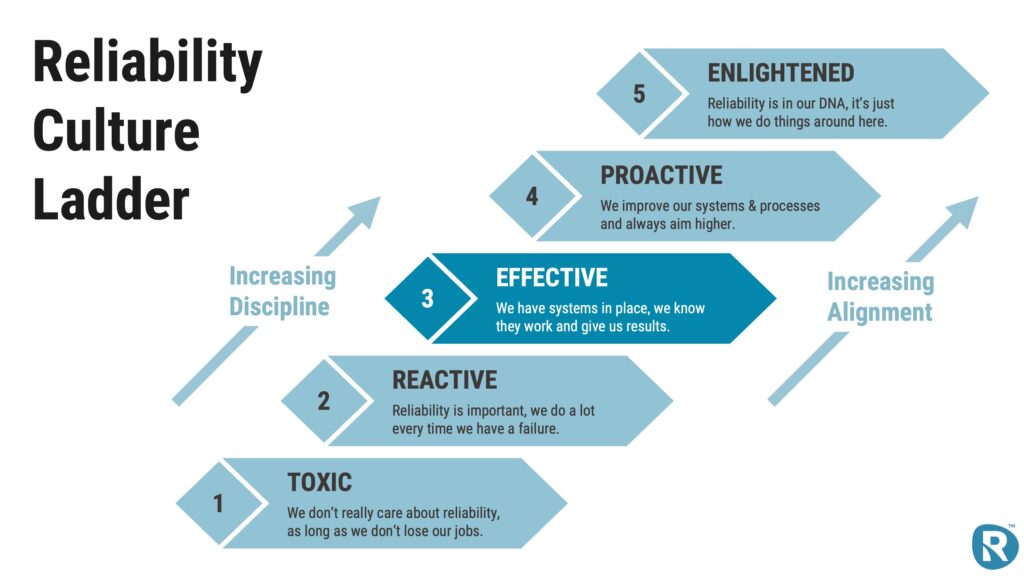
Reliability Culture Ladder. Source: Reliability Academy – Erik Hupjé. Used with permission.
Reflection
The four articles in this series show that varnish is much more than a lubrication problem alone. The topic touches reliability, maintenance culture, data interpretation, system behaviour and decision-making.
Measurements remain essential, but ultimately maintenance is not about collecting more information. It is about making responsible maintenance decisions with the information that is available at that moment, often before complete certainty exists.
This is where technology, maintenance and reliability come together.