What consumer law changes and why industrial evidence still matters across the value chain.
The central B2B point:
EmpCo directly governs consumer-facing commercial practices, not pure industrial B2B communication.
Its wider industrial relevance arises when OEMs, brands, retailers, fleet-service providers or other customer-facing organisations need technical evidence from suppliers earlier in the value chain to support sustainability claims, product propositions or supply-chain assurances.
Technology pull and regulatory push are changing how organisations demonstrate, substantiate and communicate performance.
New applications create new performance requirements. At the same time, European consumer law is making the boundaries around environmental claims more explicit. The common direction is clear: away from assumptions and broad language, and towards technical evidence, application context, measurable performance and defensible claims.
| Technology pull | Regulatory push |
|---|---|
| EV fluids | ESPR and Digital Product Passport (DPP) |
| Thermal management | Product Carbon Footprint (PCF) |
| Data centres and advanced cooling technologies | EmpCo |
| Predictive maintenance and digital monitoring | EUDR, SDPA |
| Bio-based lubricants and re-refined base oils (RRBO). | PFAS and other chemical requirements. |
Two established forces, one common direction
The forces themselves are not new. Industrial organisations have long responded to changing equipment requirements, chemical regulation, customer expectations and environmental concerns. What is changing is the degree to which these forces interact. New technologies require specialised fluids and application-specific performance, while customers further along the value chain increasingly need structured product, performance and lifecycle evidence for their own decisions and communication.
At Lubricants Expo 2026, Stephan Baumgärtel of UNITI summarised this interaction as “Technology Pull & Regulatory Push”. Technology examples included EVs, data centres, renewables and automation. Regulatory topics included ESPR and DPP, PCF, EmpCo, EUDR, PFAS and SDPA. This article focuses on EmpCo and the wider implications for claim substantiation.
Technology pull: new applications need new evidence
Electrification, higher power density, automation and digitalisation are changing lubricant and fluid requirements. Relevant developments include EV fluids, advanced thermal management, data centres and advanced cooling technologies. Predictive maintenance, digital monitoring and data-driven services are also changing how operational performance is observed and interpreted.
Sustainability-related product development is expanding the role of bio-based lubricants and re-refined base oils. These developments create opportunities, but they also raise practical questions about durability, materials compatibility, component protection, reliability, fluid life and real-world performance under actual operating conditions.
The question is not only whether a product has promising properties, but whether the required performance can be demonstrated in the intended application.
Regulatory push: from product information to substantiated claims
European regulation is increasing expectations around sustainability information, traceability and environmental communication. ESPR and the Digital Product Passport are relevant to structured product and lifecycle information. Product Carbon Footprint work creates demand for consistent data and defined methodologies. EUDR introduces traceability and due-diligence requirements for relevant commodities and products. These frameworks differ in scope, but together they increase the importance of reliable data and clear information flows across value chains.
EmpCo – Directive (EU) 2024/825 – specifically amends EU consumer-protection rules. It applies through the rules governing unfair business-to-consumer commercial practices and consumer rights. It does not turn every industrial B2B claim into an EmpCo compliance matter.
EmpCo: what changes for environmental claims
EmpCo strengthens the move away from unsupported or overly broad sustainability claims. It adds specific rules for environmental and social characteristics, circularity aspects such as durability and reparability, sustainability labels, environmental comparisons and future environmental performance.
| Claim area | Practical implication |
|---|---|
| Generic environmental claims | Broad terms such as “green”, “environmentally friendly” or similar generic claims can be prohibited unless recognised excellent environmental performance relevant to the claim can be demonstrated. Clear specification and context on the same medium matter because they can change whether a claim is treated as generic. |
| Offset-based product claims | A product may not be presented as having a neutral, reduced or positive greenhouse-gas impact where that claimed impact is based on offsetting greenhouse-gas emissions outside the product value chain. |
| Whole-product claims | A benefit relating only to one product aspect or one activity should not be presented as a benefit of the entire product or business when that wider impression is not justified. |
| Future performance | Future environmental claims require clear, objective, publicly available and verifiable commitments supported by an implementation plan, measurable targets and appropriate independent review. |
| Comparisons and labels | Environmental comparisons need transparent methods and data. Sustainability labels are subject to stricter conditions, including requirements around certification schemes or public-authority establishment. |
Why industrial B2B should still pay attention
The important distinction is between direct legal scope and indirect commercial effect. Pure B2B commercial practices are not directly regulated by EmpCo. However, evidence requests can move back through the value chain when a customer-facing organisation makes a consumer-facing claim or asks suppliers to support a customer proposition, sustainability statement or supply-chain assurance.
- A lubricant supplier may hold the test data needed by an OEM or brand to support a durability, efficiency or lifecycle claim.
- A component supplier may need to document materials compatibility, recycled content, expected life or the conditions under which a performance benefit was measured.
- A fleet or truck operator may be primarily B2B, while its customers use transport data in consumer-facing delivery or sustainability propositions.
- A supplier may face contractual requirements for evidence retention, methodology, change notification, auditability or periodic updates even where EmpCo does not directly govern the supplier’s own communication.
This creates a practical chain effect: the business communicating the claim may not be the business holding all the evidence. Technical evidence, lifecycle evidence, test conditions and claim boundaries therefore need to remain connected across functions and organisations.
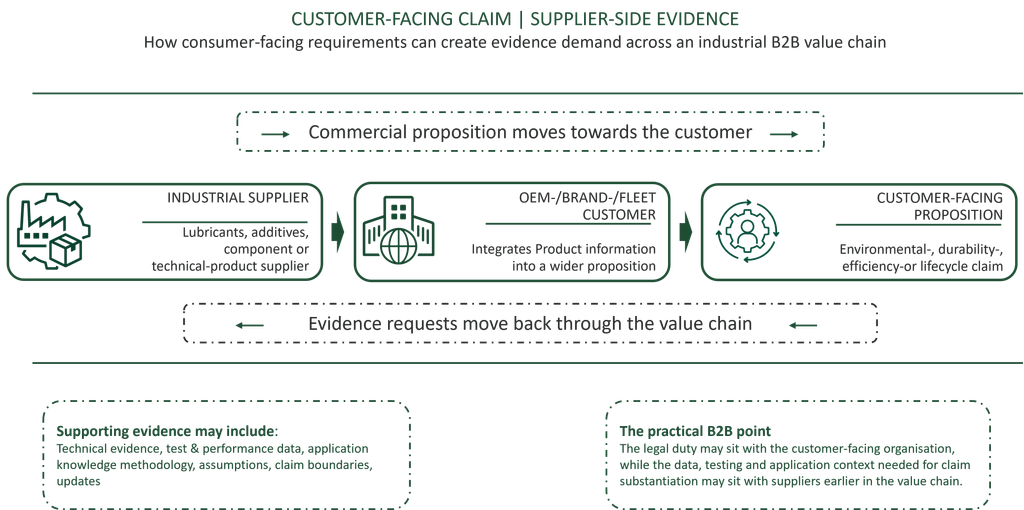
EmpCo customer-facing claim | supplier-side evidence model across an industrial B2B value chain.
Claim substantiation did not start with EmpCo
The basic principle is older than EmpCo. Existing EU and national rules already prohibited misleading advertising and required objective or comparative claims to be supportable. In the Netherlands, rules on misleading and comparative advertising also cover business-to-business communication. In the United Kingdom, the Business Protection from Misleading Marketing Regulations, the CAP Code and environmental-claims guidance have long required evidence for objective claims and careful treatment of comparisons and environmental statements.
Mature technical and legal claim governance therefore already asked familiar questions: What exactly is being claimed? Which test or field evidence supports it? What was the reference case? Under which conditions does the conclusion remain valid? Which assumptions and limitations must remain visible?
EmpCo partly formalises and strengthens established claim-governance principles, but it also introduces specific bright-line prohibitions that go beyond general good practice.
This distinction matters. It would be inaccurate to say that evidence was not required before EmpCo. It would also be incomplete to describe EmpCo as merely a restatement of existing practice. Its added value lies partly in making particular practices expressly prohibited or subject to more explicit conditions.
Technical claims and sustainability claims are related, but not identical
EmpCo focuses on consumer-facing claims, including environmental and social characteristics and circularity aspects such as durability and reparability. It does not directly govern every technical performance claim in an industrial contract, technical datasheet or B2B presentation.
General technical claims, for example about wear reduction, energy efficiency, longer lubricant life, component protection or maintenance intervals, may still be subject to misleading-advertising rules, comparative-advertising requirements, contractual commitments, sector rules and customer-specific approval processes. The evidence question therefore remains relevant even where EmpCo itself does not apply.
Where Proof of Performance fits
Proof of Performance is a framework for performance validation, performance verification and industrial validation of real-world performance. It combines the technical basis, application conditions and performance data to determine whether performance is demonstrated under real operating conditions. The framework focuses on evidence-based decisions, maintenance and credible communication – not on marketing claims as an objective in themselves.
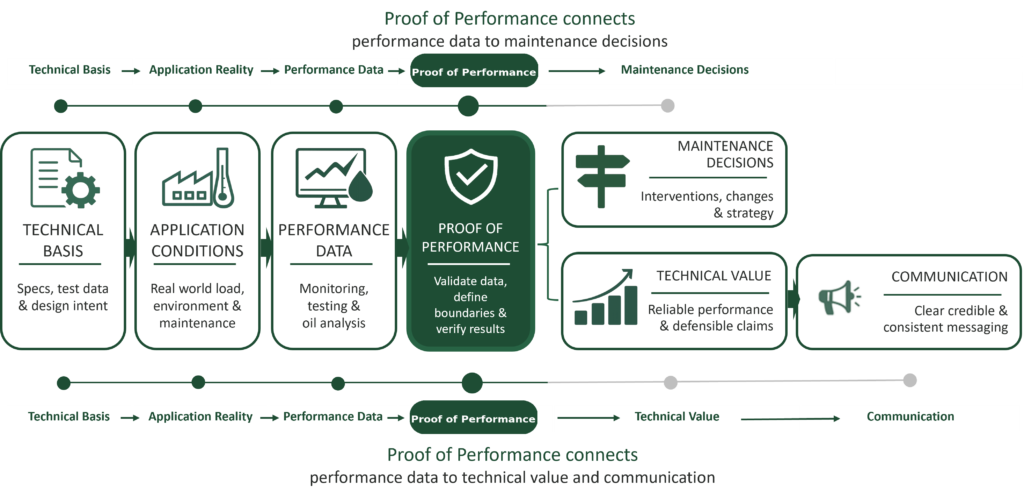
The first task is to understand what was measured and what it means in the intended application. This involves interpreting test and operational data, identifying assumptions and risks, assessing in-use performance and determining where focused performance validation or performance verification is needed. The objective is not an unnecessary test programme, but decision-ready technical evidence where it truly matters.
Proof of Performance can then support two distinct outcomes:
- Towards maintenance and application, it can strengthen maintenance strategies, technical decisions and adjustments to operating or boundary conditions.
- Towards communication and substantiation, it can provide clear and defensible substantiation of proven performance within explicit boundaries, including input for technical documentation, case studies, customer value propositions and credible Technical Value Communication.
These routes use the same Proof of Performance framework, but the application context, evidence and individual project may differ. In some cases, such as work for an OEM, the outcomes may support both internal decisions and external communication.
From validated performance to credible communication
Technical Value Communication connects validated performance with customer value, technical marketing and credible communication. It does not replace technical substance with marketing language. It ensures that technical evidence is interpreted correctly and translated into clear customer value propositions without losing the application context, assumptions or limitations that make the claim defensible.
The challenge is not always a shortage of data. Organisations may already have test reports, specifications, customer trials, monitoring results and lifecycle evidence. The harder task is often to determine which conclusion the combined evidence supports, where it applies and how the same technical truth can be communicated consistently by engineering, product management, sustainability, sales and marketing.
How Enerene supports organisations
Lubricants & Maintenance Strategy: Connects operating conditions, lubrication management, condition monitoring and predictive maintenance with practical maintenance decisions. This helps assess the practical basis for benefits related to reliability, lubricant life, asset life and resource efficiency.
Proof of Performance: Structures technical evidence, application conditions and performance data to support performance validation, in-use performance assessment and defensible conclusions.
Technical Value Communication: Translates validated technical performance into credible claims, customer value propositions and consistent technical marketing content, while preserving accuracy and explicit boundaries.
These routes remain distinct. Lubricants & Maintenance Strategy supports operational and maintenance decisions. Technical Value Communication supports credible market and customer communication. Proof of Performance is the common evidence framework that can support either route; it is not a third route that blends them.
Conclusion
Technology pull and regulatory push increasingly point towards the same organisational capability: the ability to connect technical performance, reliable data, application context and credible communication. EmpCo is directly relevant to consumer-facing commercial practices.
For industrial B2B organisations, its wider significance is the demand it can create for supporting evidence from suppliers earlier in the value chain, alongside existing advertising rules, contractual requirements and established claim governance.
The strongest response is not to treat every B2B statement as an EmpCo compliance exercise. It is to build an evidence framework that distinguishes technical claims from sustainability claims, defines what has actually been demonstrated and keeps the evidence connected to the intended application and communication.
The central question is no longer only “What can we say?” It is “What can we demonstrate, under which conditions, for which audience, and how can we communicate it accurately?
Need support with performance validation, claim substantiation or customer value propositions based on technical evidence?
Enerene Consulting helps industrial organisations connect technical evidence, application context and credible technical value communication.
Contact Enerene to discuss performance validation, claim substantiation or the generation of technical evidence for credible claims.
Reference and note
1. Directive (EU) 2024/825 of the European Parliament and of the Council of 28 February 2024, amending Directives 2005/29/EC and 2011/83/EU.
2. European Commission, Guidance on the interpretation and application of Directive 2005/29/EC concerning unfair business-to-consumer commercial practices.
3. Directive 2006/114/EC concerning misleading and comparative advertising.
4. Netherlands Authority for Consumers and Markets (ACM), guidance and information on sustainability claims.
5. UK Competition and Markets Authority, Green Claims Code and environmental-claims guidance.
6. UK Advertising Standards Authority / CAP, The CAP Code: substantiation, comparisons and environmental claims.
Primary industry reference: Stephan Baumgärtel, UNITI e.V., “European Regulation & Global Perspectives: Rules, Risks & Opportunities in a Changing Market”, presented at Lubricants Expo 2026.
Disclaimer:This article provides a technical and strategic perspective and does not constitute legal advice. Organisations should assess the applicability and precise legal requirements of European legislation for their own products, claims, markets and customer groups.